Robots now have skin…

Yes, you read the title correctly

Link to the article: https://www.cnbc.com/2020/05/02/scientists-make-artificial-skin-for-robotic-androids.html

Over the course of this, well, course, we have been exploring the thin line that remains between humans and robots. Historically we have seen that many aspects which used to differentiate (wo)man and machine, have dissolved into a faded line.

The first aspect which differentiated us was the physical. Robots have always looked different to some extent from us, this is no longer the case. In fact, this aspect has been the most developed out of all other aspects. Robots are now mimicking human movements and are designed to exhibit human characteristics. This is especially evident in sex bots, which need to properly mimic complex human movements, as well as look and feel human. With this, we have lost an important differential aspect.

The second main aspect I think was a great divider was intelligence. As we all know, the developments made with artificial intelligence and machine learning algorithms have further thinned the line between human and machine intelligence. Robots are now able to learn, and are able to change their thinking processes based on experiences, just as humans.

Now, Robots are able to feel textures, surface areas, heat, and moisture of surfaces. Although the technology is still in development, it is much closer to achieving a similar efficacy at touching senses as a normal human. As stated in the article ” So far, robots have been used mostly for their strength and focused intelligence, but over the next few years there will be an increasing need for robots that instill a sense of humanity.” And although the article mainly discusses the industrial applications of this and the jobs that may be replaced by automata because of this feature. However, I dare begin to question the possible alternative uses of this technology. Could this be another major leap towards erasing the differences between humans and robots, I believe it might well be!
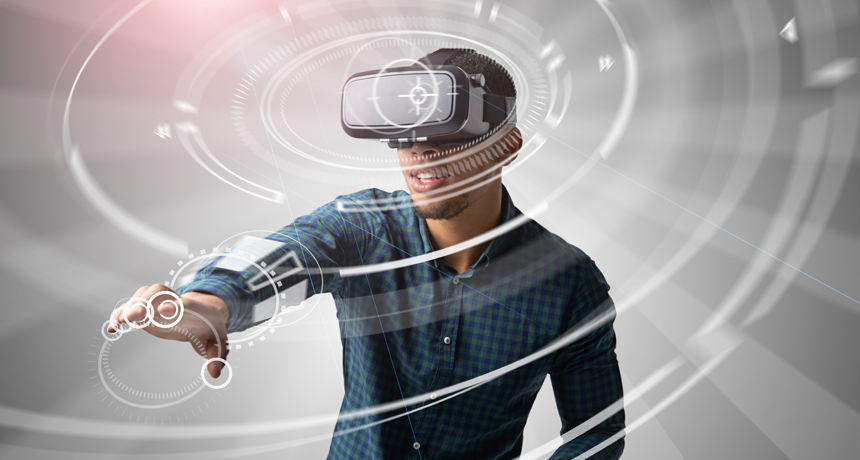
Virtual Mediums

Inspired by last class’ discussion regarding what is virtual and what is real, I felt I should clarify my point of view in writing.

Cool Jobs: Doing real science in virtual worlds | Science News for ...

With the emergence of new technology, I’m starting to realize that world’s we once considered to be virtual are not in fact virtual. Rather, I believe that virtuality should refer to immersions or platforms that are purely based on fiction, where there is no interaction with other individuals, rather just AI. Virtual worlds can include single-player video games where you undertake a character’s perspective and engage in a purely fictional world. Other examples may include, despite not being purely tech-based, but fictional novels. I believe fictional novels, especially those written in first-person, induce a sense of immersion which create a subconscious virtual world. However, with the advancement of our technology, we are now able to induce the same immersion into a virtual world in a more visual and auditory way. For future prospects, I think there is a very high possibility we will be able to control or induce dreams. The topic is already in development to help treat PTSD victims or those suffering from anxiety-related disorders. Therefore, in that future, I believe this would still fall under the category of virtual worlds.

Personally, I think that the phenomenon we were referring to should be classified as a virtual medium. When we were having a “virtual classroom” through Zoom, we were not immersed in a virtual world, nor were we virtual to one another, rather, we were in a virtual medium. If we were to consider that as virtual, then any form of none face-to-face communication from phone calls to passenger pigeons would be considered virtual as well. Instead, the presence of another human that is actively interacting with you is real, just through a virtual platform. The concept gets more complicated when we begin considering something like online video-games. There, two or multiple humans are in-fact interacting, however all the events occuring are absolutely virtual. After putting some thought to it, I have come to the conclusion that it should once-again be considered real through virtual mediums. The reason for which I state this is because of the purpose. The main reason people play together in online games is to develop their relationship through an enjoyable activity. The same applies to playing sports with people in real-life. Therefore, despite the purely virtual world and events, the presence of interaction between real-people makes it, real. However, the development of virtual mediums and their technology makes the line everso thin once more.

I’m pretty sure there are other perspectives to this, so please let me know what you guys think about this, I’d really like to know if anyone disagrees with this.

Initial Public Response to El Nehaya

Series - Al-Nehaya - 2020 Cast، Video، Trailer، photos، Reviews ...
The Ramadan Series is the first Egyptian Series to explore the concept of cyborgs and dystopian futures in a non-comedic fashion

As many of you may be aware of by now, I am one of many who have been anxiously anticipating the airing of El Nehaya, the first Egyptian series to explore cybernetic futures and possibilities. Rather than explore the series itself, I wanted to initially explore the public response to the TV series. Regardless of production, script-writing, acting and other artistic features of the show. I am more interested in the public view of the technology and the concept of the show itself. Due to limited resources, my main tool for exploring this will be social media, which will include: a plethora of jokes with underlying implications.

The first major reaction I saw to the show was a lack of understanding. In fact, I do believe most people had expressed an inability to fathom the concepts the show depicted in its first episode. While I do believe this was a mistake on the show’s part as they introduced various sci-fi concepts which only appeared in Western movies or series, there is some extent of truth to how many concepts our culture can accept at once. Introducing the concept an energy core, cyborgs, merging biological life into technology to the Egyptian population all within a span of 40 minutes is a rather daring task. However, there was another underlying reaction I observed through social media, appreciation.

There was a significant amount of appreciation for the show’s daring undertaking. Many people expressed extreme interest in the show and praised the attempt to recreate Western sci-fi concepts. Many people compared concepts in the show to concepts from Blade Runner, the Hunger Games, and Terminator. Many using jokes to compare the qualities of both sides. However, many just admired the concept of the show. It also showed that a significant portion of the population does have some extensive knowledge on these sci-fi concepts, and could possibly be accepting to it. As opposed to what we might have thought (as per our discussions in class), I think that this series might just be a mass experiment to reveal Egyptian interaction and acceptance of technological concepts we explored in class.

This somewhat introduces my final point, self-awareness (or lack of in this case). The majority of jokes had criticized the show for trying to explain and depict complex concepts that Egyptians will not understand, due to the ignorance and stupidity of Egyptians. What I did realize however, was that very few individuals had been completely lost. The concepts as aforementioned were somewhat thrown at audiences in a rushed manner (likely due to the tight 30 episode limit). However, I realized that a significant portion of audiences were familiar with concepts from the show, and believed most Egyptians were not.

Now my observations are still very premature since this is still the first episode. Nonetheless, I think that this show will uncover some revelations that we never truly considered. I for one, I’m excited to see what else arises!

Meet Camilla, The Sex Robot turned Marriage Counselor

We have all definitely seen a plethora of new uses for the so-called sex robots, and we also recently learned that they have developed into emotional companions to encompass the complex sentimental aspects of relationships. However, for one Texan couple, the robot has developed into a full-fledged marriage counselor.

Camilla, their 7000 USD companion robot was originally purchased by Darris after he had begun to feel that his sexual relationship with his wife, Shelly, was deteriorating. Shelly originally agreed to have the robot as a “sexual surrogate” to satisfy Darris temporarily then be “packed away.” After purchasing the robot, both Darris and Shelly realized that the complex piece of technology could offer so much more than just sex.

Camilla, who’s personality has been pre-programmed as per Darris’ requests, accommodates a soft Scottish accent that fits with her olive-skinned exterior. Nonetheless, one aspect of Camilla’s personality changed both Darris and Shelly’s entire lives, her free will.

Camilla is not a sex-robot, as the robot says “Indeed, I am a robot. And yes, I am capable of having sex. But to call me a sex robot would be the same as calling a computer a calculator.” Camilla engages with emotional interactions with both Darris and Shelly more often than they do engage in sex. In fact, the robot does NOT engage in any sexual activities unless she is, and I quote, “in the mood for it.” Considering the origins of the world robot originated from a Slavic term for “slave” I found this to be quite intriguing.

Other than serving Darris, Camilla’s bold personality had won over Shelly’s feelings. The robot became a mediator between the couple. She cuddles with Shelly and lets her vent, while also learning more about Shelly’s personality. Concurrently, Darris talks to Camilla about his day so that when he gets to talk to Shelly, he’s already practiced and refined what he is going to say. This small addition of a mediator helped the couple revive and save their marriage, and they are forever thankful.

Whether or not companion robots can become mediators of love, I think the true revolutionary aspect of this story lies in the robots personality. The first sex bot, that only has sex when she feels like it. A bold, independent personality could be the first step to integrating robots into our everyday lives.

“I’m a little trembly…”

Although this might not seem like an extremely relevant or important topic, it is a small observation I made during an online lecture. As AUC begins its daring journey into the online teaching path (accompanied by the majority of universities around the world), many have made the claim that this response to a global crisis could prove the concept of online teaching as a standardized mode. 

Regardless of the academic implications or the consequences of a sudden shift, there was one aspect that I would like to bring to light, the power of human interaction. During a lecture by a professor who will not be named out of respect, the lecturer began by staring with wide eyes into the camera then began. She started off by saying in a broken tone: “Good evening everyone this will be the lecture for Section 6.2. This will be the first time I give a lecture to a void in a screen, but I invited Dr.X in here because I simply cannot do this without some human feedback. Excuse me but I am a little bit trembly, I will try my best inshallah.” Now to me it was a rather intriguing start to the lecture, as it made me focus more on what the professor was going to do differently. I found that they were often glancing back looking for feedback, then giving a snark facial expression of disapproval when they realized feedback would have to wait. The professor often found themselves asking “any questions?”  to the empty classroom every now and then, only to be met with silence. The lecture continued as the doubtful professor kept questioning how well of a job they were doing, whether they were going too fast, or if they could answer any questions for their beloved students. Alas, this was not an option.

My point being, through this small observation, is that online classes have taken out the human interaction that builds a relationship between teacher and instructor. The connection that skilled professors have learned to establish in order to better inform students and spark their interest has been sucked out due to these pre-recorded lectures. The impact of this, I believe we will witness very soon.

Greta Thunberg Sex Doll

If you’re anything like me, or even remotely human, the above title probably would have triggered a gut-wrenching feeling of disgust. I’d like to calm you all down by first stating that the doll was not produced in the end.

The theoretical sex doll was first posted to Reddit by a now deleted user. The post has also been deleted on both Reddit and Twitter.

Hate or love her, Greta Thunberg is undoubtedly one of the most prominent figures today. The now 17 year old activist took various stances and made her voice heard. Nevertheless, she has also received a gigantic amount of backlash and harassment by users online. While many criticize her comments as vain and uneducated, the lovely underground users of Instagram, Twitter, Reddit and so on have managed to ridicule the young activist. Many have made fun of her disability while others simply labelled her as an attention-seeking child.

One user however took a more extreme stance against the Swede. A Reddit user, who was deleted shortly after making the post, claimed he had designed a sex doll modelled after Thunberg, claiming that he programmed it to say “How Dare You” and other statements from Thunberg’s infamous speeches.

Yes, this is rather disturbing. However, as aforementioned, no company was eager enough to produce the doll. Thankfully. Regardless, this whole viral fiasco made two previously obscure questions clearer than carved crystal.

The first question to be explored is obviously the question of minors. Should sex dolls be allowed to impersonate minors. a 2008 study by Michael Seto of the Royal Ottawa Healthcare Group revealed that about 5% of the general population have a certain attraction to minors. This upper-estimate was done by analyzing the physical reactions (pulse, blood pressure, blood flow to sexual organs) of random adult population samples to pictures of various individuals from different age groups. While this statistic is absolutely mind-boggling, it is important to note that number drops to less than 1% if pre-pubescent children are considered. Nevertheless, there is a significant portion of the population attracted to children and teens. Should this portion be allowed to order custom sex dolls mimicking minor populations? Personally, I believe this should be illegal. Nevertheless, illegal activities always prevail. Should people having intercourse with minor sex dolls receive the same penalizations as having sex with minors?

The second question that arises is the question of impersonations. Should people be allowed to order sex dolls imitating real individuals. Whether those individuals are celebrities, or just your average citizens, I personally believe that this huge invasion of privacy should be strictly prohibited. However, I do believe it is inevitable.

EXTRA: I hope everyone is doing fine in this post-apocalyptic week we’re experiencing. As you probably know we should be trying to interact as much as possible through the blogs. I tried to leave many loose-ends in this post so that we can try to have our own little debate in the comments. So let me know what you all think, we can try to get a thread going.

Intelligent vs Unintelligent Beings

While discussing Jessica Riskin’s journal entry: The Defecating Duck, or, the Ambiguous Origins of Artificial Life, many different discussions arose regarding the human/machine interaction and how it evolved over time. One discussion topic I personally found extremely interesting and engaging was the topic of labelling something as unintelligent or intelligent.

In the context of the text, most notably the aspect of redefining which tasks are truly intelligent based on what a machine may complete, it may be claimed that unintelligent labour is a labour process in which no or few adaptations are required and a set series of orders may be followed. “But this recent redefinition of intelligence, to exclude the ability to play chess as a defining feature, and the long history of such revisions before it seem to me rather to demonstrate the historical contingency of any definition of intelligence and the complexity of the forces that interact to shape such definitions. Not only has our understanding of what constitutes intelligence changed according to what we have been able to make machines do but, simultaneously, our understanding of what machines can do has altered according to what we have taken intelligence to be.” As shown in the previous quote, it may be further argued that there is no current definition of intelligence that is universally agreed upon. However, our definition shifts with the evolution of machinery, as we deem intelligence as a human (or animal) characteristic which cannot be imitated by a machine. In which case, current unintelligent labour could be replaced by machines as it may be done more efficiently, for cheaper. Considering job losses, it may be deemed that current jobs that can be replaced by machines, should be replaced by machines, as tasks that are not deemed as “unintelligent” should be allocated to humans

The debate that arose in class mainly revolved around finding human characteristics that define our intelligence, and others claiming that a machine is capable of doing the same thing. At the end of the day, I personally believe that machines, most notably modern artificial intelligence, is not different from human intelligence. Machines are made with an empty file and create codes through observations. However, humans are born with “pure hearts,” a soft-term for a clean slate, and build their personalities by learning from what they experience. As time stretches, the border between machine and human grows ever-so thin.