Robot Recruiters to end work discrimination?

There is no doubt that we have some discrimination issues in the workplace. There are an unlimited amount of stories on women not getting equal pay for equal work, glass ceiling, managers preferring workers of certain color or maybe interviewers giving the job to the candidate with the higher social status instead of qualifications. but what if these interviews were conducted by a robot recruiter? one that neither knows or cares about a candidate’s race, gender, religion, appearance or any other potentially influencing factors?
While some people feel uneasy about the idea of robot-cops or robotic doctors, the benefits of a robot recruiters far exceed any concerns and the idea is actually pretty reassuring. ‘Furhat Robotics’ have developed such a robot named Tangai that has been getting tested since last October in a recruiting firm and was proven very successful.

Tangai is a disembodied robot head with a friendly approachable face designed to mimic humans’ speech and mannerism. In addition to not having bias, this robot also does not do small talk in the interview to ensure that it only record work related answers. It asks the questions in the same sequence and the same tone then it gives the transcript of the interview to humans recruiters or managers to assess the candidates and decide accordingly.

Of course, no matter how promising these robots are, we need to keep working on tackling down our human biases. This discrimination phenomenon is worldwide and it does not just happen in the interviews but also at the CV assessment stage and even after the candidate start the job. It would be foolish to think we could just use technology to solve this issue without educating ourselves on this social and ethical issue.

Resources:

https://www.independent.co.uk/voices/robot-ai-work-discrimination-racism-unconscious-bias-a8838516.html

Why are people phone addicts?

Did you know that even Steve Jobs, when he introduced i-pods to the world, limited the use of technology for his children at home? yet we still allow ourselves to fall into this trap of phone addiction! but why? phones are not drugs so why can’t we put them down? because addition is not about pleasure, it is about soothing psychological distress. It’s using something to cope with a problem in life.

Adam Alter, a professor of marketing at NYU and author of “Irresistible: The Rise of Addictive Technology and the Business of Keeping Us Hooked”, says in his book

“You only develop an addiction when there is some psychological motive that hasn’t been fulfilled for you: loneliness, that you’ve been bullied, or you can’t make good things happen in your life. It doesn’t actually matter what you use to soothe that addiction, whether it’s playing a particular game that lulls you into a distracted state or whether it’s taking a drug. In terms of soothing those psychological ills, behavior and substance addictions are very, very similar”.

To demonstrate just how attached people are to their phones, he conducted an survey where he asks young adults whether they prefer to have a bone broken or their phone broken. and the results were truly shocking, he says “Forty-six percent of people would prefer to have a broken bone than a broken phone. But even for the 54 percent of people who say they’d prefer to have a broken phone, it wasn’t a snap decision. They agonized over it.

We live in an age of anxiety. And YES phones can soothe that anxiety. But they can also add to that anxiety. and the device we use to sooth our cranky or boring days could turn into something that keeps us from living life fully. The really concerning aspect is that we see people who are not even aware they are addicted to their phone, they truly believe they are just enjoying their time. yet, these are the same people we find them complain about how little time in the day to do the things they love or how they have no time for going to the gym or to even study.

Resources:

https://theweek.com/articles/688639/5-sciencebacked-ways-break-phone-addiction

Virtual Therapy as a New Way of Treating Fear of Public Speaking

Recently, a group of Virtual Reality experts, psychologists and former engineers at Google and Facebook teamed up to use the VR technology to tackle phobias that humans have struggled with for centuries; including social and anxiety and fear of public speaking.

The Idea is that it builds on traditional exposure therapy, a common and effective treatment for post-traumatic stress disorder and phobias. but the only difference is with this technology, the patient can get as close as possible to the real life without actually being in Real-life.

VR has great potentials in helping people overcome mental health problem and it’s getting more and more accessible everyday! According to Forbes magazine, Until recently VR systems were expensive, clunky, and wired to a desktop PC. Today a therapist can buy a mobile Google Daydream headset for about $70.

What is really interesting is how they can program the virtual audience into giving different reactions according to the patients fear. as you can see in the video bellow where they control the experience into becoming as close to the patient’s biggest fears as possible. The experience is very realistic in which the audience is real characters not animated and they even have a version of your PowerPoint presentation in front of you. The variety of audience reaction range from the casual audience which is least distressing to a disengaged audience of people fidgeting, yawning, or staring at their cellphones and computer screens. 

By controlling the dose of the anxiety-provoking situation in a VR environment, a trained therapist can help patients manage or overcome their anxiety.

Resources:

Forbes article: https://www.forbes.com/sites/carminegallo/2017/08/27/a-virtual-therapy-for-stage-fright-thats-remarkably-realistic/#4d9086655f90

The video of the experiment

Is violence against robots caused by economic anxiety?

Violent actions directed toward machines is not a new phenomenon. However, they have been on the rise lately. According to an article in the New York Time, multiple cases of humans attacking robots have been documented lately. In June 2015, a hitchhiking robot was assaulted and dismembered in Philadelphia brutally, then a sex robot called Samantha was attacked and destroyed at an electric show, then a man in Russia attacked a teaching robot with a baseball hat. In 2018, it started getting even worse as a man waved a gun at a self-driving van called Waymo as it just passed through.

Even though Luddites have done it before and demonstrated their fear of machines taking over their jobs and all of that, this now emerging phenomenon seems to be more and more popular with humanoid machines especially; which makes us wonder whether this violent hatred has an economical aspect as well or is that more cultural?

In the New York Times article “Why Do We Hurt Robots?”, it’s suggested that
the violence may be caused by economic anxiety. In other words, there’s a deep fear that the machines could collect their jobs in the future. While i agree that this fear is justifiable and maybe true, i can’t help but feel there’s a more social aspect to our behavior. could it be that humans beat robots up because they simply look at them as outsiders? and we are just afraid of them because not only they are unfamiliar and unknown to us but they also look similar to humans?

To investigate this, they did a social experiment in a Japanese mall after an incident of three boys beating a humanoid robot. in this experiment a robot is patrolling in a shopping mall and is attracting the attraction of mostly children, eventually he comes across someone and asks to open the way. Some children complied; however, some refused and persistently hindered the robot (as you can see in the video linked below). this happened more often when children were grouped together and parents were not on sight, and it occasionally lead to violent behavior.

74% of the kids described the robot as “human-like,” and 50 percent of the children believed that their action was “stressful or painful” to the robot. In other words, the children hurt the robot even though they perceived it as life-like.

so we may keep blaming our fear of robots taking over or robot uprising for our lack of empathy and violent actions. however, it seems like we ourselves have a social tendency to become violent toward anything that we consider ‘outsider’.

Resources:

experiment: https://youtu.be/CuJT9EtdETY

Robot Theatre Project

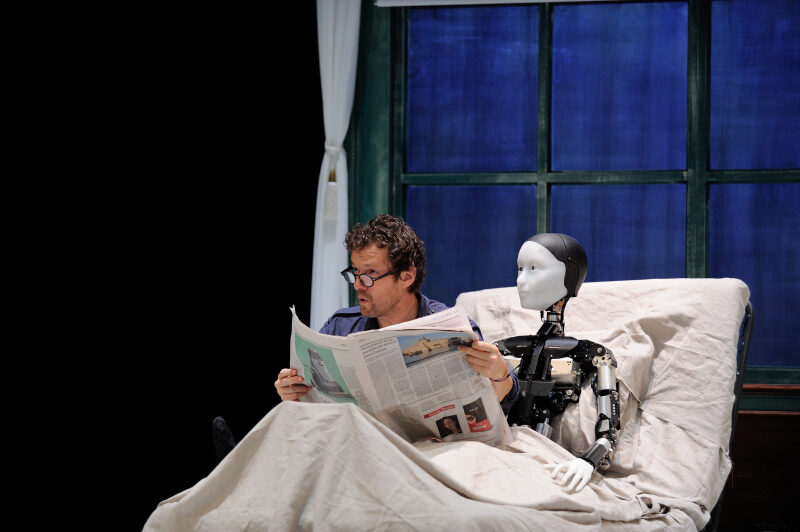
While i was researching roboethics for my final project and the different theories regarding the future of robots in the society, whether they should have rights or not, possible ethical concerns and whether humans would accept and get used to the interactions with them, i came across this really interesting Japanese artistic project called “The Robot Theatre”. The idea of the project is very simple as you can see in the attached photo, they make robots act on stage and ‘naturally’ interact with other human actors.

In Japan, the development of humanoid robots has been in the top of their research list for decades. one of their approaches to integrate them into the society is to make them a common sight in various situations; not just in movies but in restaurants, hospitals and now theatres. What most interested businesses are trying to do is creating a friendly image of the human- robot interaction and removing the negative one where robots take over human labor and leave us all jobless. of course such a threatening prospect produce fear and unease that would be connected to robots and would prevent them from purchasing one as a life companion in their houses. so how would a theatrical performance affect of our views on robots and interactions in general?

In these theatrical performances, the robot is not there to showcase “oh look what a robot can do!”. The robot actually perform different characters with different depths and the shows emphasis the importance of human- robots co-existence through the tool of art.


Creating robot theatre performances has been a collaboration project between Oriza Hirata, (a very well known director) and Hiroshi Ishiguro (remember the professor who did a robot replica of himself? that’s the guy!), the leader of the Intelligent Robotics Laboratory at the Osaka University. They both agree on one thing, it’s not hard to define what a robot is, what’s really hard is to define what is a human! The body of the robot is just a shell. however, they program everything done in that performance from voice recordings, to movement programming to finally making the robot show emotions. the question which they try to raise and think about everyday is whether these emotions shown on stage and assumed to be spontaneous human reactions are actually spontaneous at all or just a pre-programmed and acquired reactions ?

so what do you think? would you pay to go see a play where the lead role is a robot?

resources: https://thetheatretimes.com/the-gaze-of-the-robot/

The space of the gods

Having the ability to watch over others while they cannot see you, from far far up, predicting their behavior while they’re not even aware there is anything up there other than god. I can imagine that you’ll very easily feel above all, a power-madness situation, or perhaps power-blindness.

No, drone operators are not blind to the limitations of their power, but drone operators are blind to its consequences on them and on other people. when they kill people on the screen, it’s just like ‘playstation’ and i can see why it would seem easy and of no consequences, you just give a command from your joystick to the screen and the target dies. but the truth is innocent civilians might have just been murdered, and it’s not the technologies’ fault.

Yes, the distance between the drone operator and the target makes violence or killing psychologically approximate compared to a regular soldier on the field, but on the other hand, the operator gets to observe the community for weeks. does seeing families and kids that you’ve got to know die counts for nothing? and while the on-ground soldiers get to see the agony on the faces of their targets, hear their cries and perhaps feel the reluctance to kill them which is the ‘normal’ human reaction before becoming murderers, drone operators gets to experience a different and more intimate experience which is seeing the consequences of their actions. It can never be a shoot and run, because they will have to sit and watch the bodies burn to the ground, they have to deal with commanding a kill then finding that the killed targets were just innocent civilians including children, they have to watch the injured crawl on the field trying to find help with their missing limps. They see all these details, yet i still say they are blind to the consequences.

while this chapter showed drone operators being involved in their activity through this screen to the degree where they physically feel present there, or where they feel emotional connection to what they see, I don’t think they get to realize it’s ‘real’ until it happens and take some times to settle in. They release a missile, ‘accidentally’ killing two children then they sit and try to absorb what had just happened, after the deeds are done.

Does the word “human” even define us anymore?!

For starter, I would like to say that reading about current movement like “posthumanism” and “transhumanism” is exciting! exciting when i think about a term that google auto correct does not consider a word yet, exciting that i am thinking of an issue but i have no actual solid proof to direct my train of thoughts to what is more likely to happen in the future. In other words, new is exciting!

While reading “Cochlear Implantation, Enhancements, Transhumanism and Posthumanism: Some Human Questions”, there was one thing that caught my attention? while we have been previously discussing in class whether we should consider cyborgs as humans and give them rights and citizenship? and whether we should consider humans with technological implantation as cyborgs or human-cyborgs? this piece drives us to a new question which is, will non-enhanced humans be considered humans in a world where the ‘normal’ is to be enhanced?

The article already suggests that moral enhancement will soon follow after physical enhancement, and it also discuss issues regarding identity and the community and how parents might be to blame if they prevent their children from the ‘advantage’ of being technologically enhanced! how these non-enhanced individual might face social difficulties and maybe even discrimination (discrimination is mostly my driven conclusion, not necessary mentioned in the article).

The word “human” in general has always refereed to something more than what we are, an open notion in a way. Darwin’s theory of Evolution is basically all about how humans adapted to human earth, and we came to be as we are. There are other theories about how humans are connected to their environment and ecology and in continuous change. Could it be just a matter of adaptation before we all lose the ability to even survive without some sort of cyborg enhancement?

Are machines trying to mimic humans or are humans trying to mimic machines?

In earlier readings, we explored the idea of humans basically being god’s Automata on earth, programmed to serve without having the control we think we have. That was a really interesting idea regardless of the fact that no religion would want you to think of it that way for obvious reasons. and since religions remain a taboo subject, stories about Automata usually involves humans inventing machines/ creatures with the ultimate goal of making it function as a human being. However, the thing i want to focus on is something mentioned in “Enlightened Automata” which is how nowadays with all the technological advancement, we are leaning toward trying to mick the performance of the machinery instead. Schaffer raises the question of whether the worker operating a machine in a factory with following certain movements without understanding the mechanism behind it is any more intelligent than the machine he is operating? whether the soldiers being ordered to kill in battles sometimes without having a say or understanding why are any more free than a slavery machine? Isn’t that why we build machines? for labor. doesn’t the word robot means slave for human? what about the humans who are slaves for humans?

Just like machines wouldn’t exist without humans, we are at a time when we can not imagine our lives without machines. and even though we can argue that the factory worker have the mental potentials to learn the mechanism of operating a machine and the soldier must’ve had a choice of joining the forces or not at some point, The reality says something else.

In countries with huge populations like China, we can see them in schools treating kids like literal robots, expecting a certain performance with a certain quality done in specific time which is similar among all students. Of course this is done with the “intentions” to prevent chaos but it ends up programming robots.