Children NObots? But, They’re Liku SOUL’d in Asia!

For how long has been man trying to achieve this feat; creating artificial life is an endless quest that humanity has been undergoing since the dawn of time, but dealing with that “product” is not an emotionless process. From alchemical transmutation ages ago, to modern-day Asian robotics, creating an artificial humans, and lifeforms has been the target for many scientists, alchemists, designers, roboticists and engineers. In the olden days, they would follow the more logical process and try to create artificial life from scratch, meaning that would start as a child and would grow. This could be seen in the myth of Golem, the scientist guy who hated and wanted to eradicate women from the face of the earth, and thus wanted to create life, without our help, and other I do not recall at the moment. However, that would, of course, be a disaster, nowadays. Why?

Oh, the children, the children, THE CHILDREN! The image of purity, the epitome of candour and ALL that is good and well! Blimey, I call SHADE! Children are human, born as a seed for BOTH good and evil, it all depends on which they nurture, the good seed or the evil one! But, how can they be considered as the bodies or the vessels of artificial lives of what might be the undoing of us all, of the termination of humanity, according to the West, of course!

Creepy Evil Children – Village of the Damned (NOT Robots, Aliens probably, but still creepy)

Creating artificial life is a multi-dimensional process with many layers and aspects that are not necessarily quantified. On the other side of the world, you have the Japanese embracing human-looking robots and treating them like humans, or like they have a kokoro. You can also see how the Koreans have created a child-looking, companion robot, called Liku, that will be available to be purchased soon by the masses.

Liku enjoying Sakura season

Liku has her own emotions, reacts to people, her surroundings, and has her own Instagram page. Liku has a soul, Liku has kokoro, and it would be a pleasant change to treat robots like that, even if they have the physique or the looks of a hume child.

Liku taking a whiff of her favorite Pumpkin Spice Latte

Humans vs Robots

Kokoro is a Japanese word which describes the heart, spirit, soul, mind…etc all together. In Japanese language, the heart is divided into the actual physical organ (shinzou) and that concerned with love and emotions (ha-to). The idea in Japanese culture is that the mind and body are indivisible and intertwined and hence the term ‘Kokoro’. Kokoro can’t be translated into English since its translation would be ‘mind AND body” which implies that they are two different things. This is exactly the opposite of the purpose of the word which is unifying the body and soul. The Japanese claim that this concept enables human to look into spiritual aspects in a way they couldn’t have if the body and soul were treated as separate entities. They believe that looking into the more inclusive picture of humanity helps us understand what makes us humans. Testuya Sato, director of the Earth Simulator at the Japan Agency for Marine-Earth Science and Technology says that humans used stored memories to anticipate what may happen and are usually clouded by desires. On the other hand, machines lack creativity. They are methodical and can never cause chaos since they are deterministic. This lack of chaos is what makes us unique and why Sato thinks that we still haven’t given robots a Kokoro. He states that this would never happen unless a robot displays spontaneity for instance if he hits his creator. Then and only then we can say that a robot has a ‘heart’.

The idea of kokoro in other organisms has already helped us in understanding some aspects about human behavior. For instance, through comparing chimpanzees’ drawings with that of young children, we were able to understand human personality traits. This wouldn’t have been possible unless we believed that chimpanzees had a kokoro.

https://qz.com/946438/kokoro-a-japanese-word-connecting-mind-body-and-spirit-is-also-driving-scientific-discovery/

Robot Theatre Project

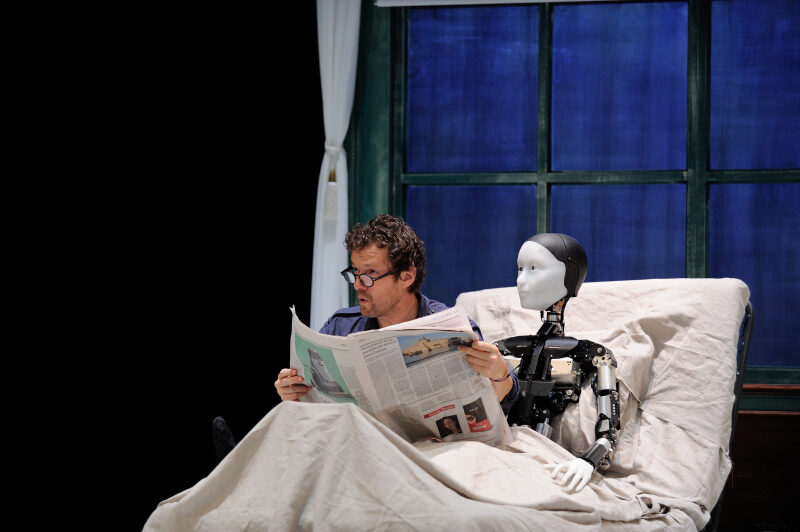
While i was researching roboethics for my final project and the different theories regarding the future of robots in the society, whether they should have rights or not, possible ethical concerns and whether humans would accept and get used to the interactions with them, i came across this really interesting Japanese artistic project called “The Robot Theatre”. The idea of the project is very simple as you can see in the attached photo, they make robots act on stage and ‘naturally’ interact with other human actors.

In Japan, the development of humanoid robots has been in the top of their research list for decades. one of their approaches to integrate them into the society is to make them a common sight in various situations; not just in movies but in restaurants, hospitals and now theatres. What most interested businesses are trying to do is creating a friendly image of the human- robot interaction and removing the negative one where robots take over human labor and leave us all jobless. of course such a threatening prospect produce fear and unease that would be connected to robots and would prevent them from purchasing one as a life companion in their houses. so how would a theatrical performance affect of our views on robots and interactions in general?

In these theatrical performances, the robot is not there to showcase “oh look what a robot can do!”. The robot actually perform different characters with different depths and the shows emphasis the importance of human- robots co-existence through the tool of art.


Creating robot theatre performances has been a collaboration project between Oriza Hirata, (a very well known director) and Hiroshi Ishiguro (remember the professor who did a robot replica of himself? that’s the guy!), the leader of the Intelligent Robotics Laboratory at the Osaka University. They both agree on one thing, it’s not hard to define what a robot is, what’s really hard is to define what is a human! The body of the robot is just a shell. however, they program everything done in that performance from voice recordings, to movement programming to finally making the robot show emotions. the question which they try to raise and think about everyday is whether these emotions shown on stage and assumed to be spontaneous human reactions are actually spontaneous at all or just a pre-programmed and acquired reactions ?

so what do you think? would you pay to go see a play where the lead role is a robot?

resources: https://thetheatretimes.com/the-gaze-of-the-robot/

The Dark Side of Mobiles

Smartphones have transformed our lives in many ways. One has become able to contact friends and family members, be updated with what is happening in the world, share his/her ideas and work, attend a lecture, watch movies, listen to music, play games, order food and groceries, book an appointment with the doctor, buy a flight ticket, and other many things while lying on bed. Indeed, this small, intelligent, and convenient machine has become a necessity in our daily life that we cannot imagine how we would function without it. Nevertheless, have you ever saw the Facebook account of that waiter in the coffee shop you visit, that classmate whom you cannot withstand, or even that man who commute to work by the same bus use to go to college as a suggestion in the category of (people you may know) even if you do not have any relations with them or mutual friends? While wondering about the weird suggestion you had, you might ask yourself whether there is a possibility that this device can be smarter than us as users? Does it have the potentiality of deceiving, monitoring, and harming us? In other words, does it have a dark side we are not aware of?


Those questions can be answered by analyzing how people who live in the other side of the aisle and offer us free or almost free service through our mobiles get benefited from us; mobile applications are excellent examples for such analysis. Each app you download on your mobile has that long page terms and conditions, which we often do not bother to read it and click on agree to proceed to install the application. By doing so, you permit those applications to get access into your mobile features and information such as addresses, contact information, friends’ information, etc. The company of a particular application starts gathering information about you once you download and use its application. They can get very personal details by using artificial intelligence and algorithms developed in the program you downloaded; they can know how you spend your day, where you go after classes, and how long you stay in that coffee shop. Those data can be analyzed to know your personality such as what you like to do for fun, how you think about this or that issue, which store you like to buy clothes from, how frequently you use transportation, etc. After identifying you – for instance – as a student who likes sport, spends some time in Starbucks’s on weekends, and go to cinema frequently, companies like Facebook personalize and customize the advertisements you would interested or at least that would be relevant to you. You may not bother to check the advertisement because you are already getting bombarded with commercials all day. However, repetitive ads – as several other advertising techniques – have proven their effectiveness in influencing people’s subconscious minds, leading them to have preferences towards certain brands and products unconsciously. Therefore, by having access to your life and other thousands if not millions of people’s lives, companies sales increase, Facebook and alike applications get paid for their magnificent work, and you end up buying clothes from an expensive brand not because its products are better than other brands, but because you have been exposed to its different ads and commercials in different places and times, one of which was when you were playing a game or socializing on the internet using free applications on your mobile. You may think that this such a greedy and unethical way of making money that depends on deceiving people and affecting their choice, and it is. However, it is not the only way of utilizing mobiles.


The more data are gathered by the company of an application, the more effective powerful, and dangerous the use of this data will be. Facebook, for example, owns Instagram, Messenger, What’s up, Masquerade, and Moves App besides Facebook application. This intercontinental company, consequently, has a huge personalized database about hundreds of millions of people around the world. In 2018, it was revealed that millions of users Facebook accounts had been used by a political consulting firm called Cambridge Analytica, which used the users’ information to influence public opinion. Such a scandal caused many countries in the world such as those of the European Union to legislate laws that protect users’ privacy information. This incident is very dangerous and alarming as people freedom and democracy are getting subjected to companies and parties. Moreover, There is an application called WeChat in China that went viral since its launch in 2011. This company of the application has partnerships with governmental services and several businesses which made the application a combination of Facebook, Instagram, What’s Up, Skype, tinder, Otlob, Uber, Visita, Wigo, Amazon, Paypal, and other applications and services. The app has become very convenient for Chinese users who exceed a billion users and who can literally spend the whole day using the application while practicing his/her life. Such usage results in a massive database that does not only show users’ personalities and preferences but also reveal what they do from waking up to going to bed. On the other hand, WeChat could not guarantee any privacy criteria, and the Chines government is known for censoring and monitoring the public. In other words, people of China live on a single application that can be monitored and observed by authoritarian governments like China, meaning that the government can know every single move one makes!.


Applications are not the only example of how people use smartphones to deceive, influence, censor, and harm others. There are free WiFi and public charging services that fulfill the same mission. Smartphones are not any different from machines and technologies that get consumed and used to benefit certain people and cause harm to others. The main issue is that they are not publicly perceived as a possible threat. And the question that comes to one’s mind is, do we need to wait until smartphones get noted identified and denoted as a threat that makes people react repulsively and violently toward mobiles, where a new era of Luddism would come?

Interesting Videos about mobiles and WeChat app:

Who’s Really In Control Of Your Phone? – Do Not Track (Part 4) | AJ+
https://www.youtube.com/watch?v=vqfgcw-v_fA


How China Is Changing Your Internet | The New York Times
https://www.youtube.com/watch?v=VAesMQ6VtK8


WeChat: How One App Came to Rule China | TRT World
https://www.youtube.com/watch?v=sRzgzyhafzM

The Robot’s Heart: Tinkering with Humanity and Intimacy in Robot – Building

The author of this reading explores the processes and mechanisms that give humanoid robots additional features which result in the development of a relationship between humans and “inanimate” subjects. The anthropological fieldwork the author discusses takes place in Japan, where the world-wide “Robo-One” competition takes place. This is a competition where engineers dedicate a lot of their time, energy, and research to building human forms and stimulating human movement robotically. Roboticists have managed to create robots that exhibit several types of human movement, such as walking, jumping, and even doing karate. However, the new surprising part is that these robot creators are trying to develop a relationship between humans and robots through a metaphorical “heart”, also known as the “kokoro”, hence explaining the article’s title. This “heart to heart” relationship is established through tinkering, which is when the relationship between the human and the technological object becomes intimate through repeated touch. By constantly interacting with the machine, and experimenting with it for trial and error, its creator develops a sense of attachment that is enacted through a complex web of bodily and emotional rituals. The presence of a “heart” in the robot greatly contrasts the purpose of the artificial intelligence created by the United States since the 1970’s. Artificial intelligence only equated the mind with intelligence, whereas the heart equated it with emotional exchange. Consequently, this caused robots to replace the presence of humans in several environments, such as in schools, households, and healthcare facilities. Due to the loss of the human to human contact within the Japanese community, people in Japan are reasserting their own type of humanity through robots. Personally, I do not blame the Japanese for the way they handled the situation, as the presence of robots is what allowed them to resist the effects of Japan’s economic collapse. Nonetheless, this makes me wonder how Japan’s future will be like especially when the robotics’ business is very much respected and appreciated. In other words, to what extent will the Japanese be satisfied with the presence of these robots over real-life humans?

sex dolls and robots

when i saw the videos about the sex dolls and the robot called Erica i was horrified. i was scared by the fact that these things are becoming so human like and are developing day after day. first when i saw the sex dolls and robots i was shocked of how they look so real and so human like, but what shocked me more is Erica the Japanese robot. Erica’s intelligence and the way she can keep the conversation going on is so human like. the problem is that humans are creating things that may be a huge threat later on. Robots like Erica may destroy the world in the future and she said that at the end of the video. Humans just want to create new things that they would be recognized for but they do not know the consequences of their creations.

Fem-Fem-Fem-Fem-Femme FATALITY!

Oooh, the Scantily-clad, the super mad and always ready to attack! With power coursing through their veins and having the ability to crush any opponent with just a glimpse, they are still portrayed as hyper-sexual little nymphs! No representation, whatsoever either! Here’s a list of 100+ cyborgs, androids and robots in anime and cartoons. It’s mostly … See for yourself!


Major Motoko Kusanagi from Ghost in the Shell

https://comicvine.gamespot.com/profile/fred9101/lists/female-cyborgs-robots-and-androids/17127/

I want some chunky mama cyborg to go and save the day with a “cool as a cucumber” attitude and fantastical body enhancement, that make HER the epitome of human kind, not some random buff guy!

Lieutenant Jennie K. Lynn from Down the Street (my notebook)

But, it doesn’t matter what they say, because fans will always be ogling their bodies anyways, and female cyborgs are commodified and are sold as a product to the masses and are used to “service the fans” to milk them as much as possible and squeeze out the last penny out of their pockets, and that of course is through larger “breast enhancements” and scantier bikinis, of course, not “X-ray vision” or “super stamina or speed” or God forbid “technomorph”, which by the way is super cool and means a cyborg  can assimilate technology with their own body to either repair themselves, gain knowledge, or gain a new ability. Awesome, huh!? BUT, of course, that’s strictly held for the men, so yeah.. Till when will we accept females being adorned in almost nothing freezing their assets off out in the cold, wasting their energy and power regulating their body temperature instead of fighting off crime using super awesome powers that their MALE counterparts are readily handed on golden plates whilst the ladies just pose in the background looking gorgeous and deadly? They obviously do the dirty work in the end, because they ARE that good! Wonder Woman, anyone? Anywho.. I mean cybernetics was supposed to level out the field and give us leverage and have us both start from the same point, since we both rise from the same power level, YET HERE WE ARE, ONCE AGAIN! Why do they still keep getting favored!? I am still confused, and honestly a bit furious!

The Blessings of Automata in Modern Era

Due to the continuous technological progress nowadays, we are getting used to use these technologies and sometimes totally rely on them while using machines and devices in our daily life. In particular, because we adapted to the intangible interaction with those machines, we think they are granted things in our surroundings and hardly can imagine how we will function and practice our daily activities without using them. Therefore, we may not appreciate the benefits of those devices because they are available all the time and we have not experienced their absence in our life. I happened to be incapable of using most of nowadays machines and devices when I was in Yemen during the first six months of the current conflict there. During that time, I was deprived of using several machines considered as necessities in the twenty-first century.
Before illustrating how miserable my life and many Yemenis’ went due to the inability of using many machines and appliances, the situation in Yemen needs to be known. Conflicts between political parties and groups and the government had been evolving since 2014, and those conflicts manifested in the intervention of other Arabic countries to supposedly aid the government on March 26, 2015. Right after this date, electricity was cut in almost all the governorates, and there was a lack of oil products like the benzene and gasoline. Due to the power shortage, most machines stopped working. Those machines range from individual devices such as mobiles and laptops to house appliances like TVs, refrigerators, washing machines, sweepers, irons, heaters, etc. in addition to the machines in bakeries, factories, hospitals, and other buildings. Nevertheless, as humans of the twenty-first century, we could not live without many of these machines, so we managed as individuals to find other ways of electricity supply to generate a small amount of electricity that could power a limited number of machines and devices such as mobiles, TV, laptops, and sometimes blenders and washing machines for those who were considered to be privileged. In this article, I will describe the sufferings my family faced as a middle-class family because machines like water pumps, heaters, refrigerators, conditioners, and washing machines stopped working.

Since electricity was cut in most cities in the country -including the one I live in, Sanaa – public water companies could not pump water to the houses. Therefore, people got water through water trucks, and those who could not afford it had to depend on free water tanks filled by wealthy people as kind of charity. Besides, people were able to afford the water from the trucks could not pump the water to the containers on the roofs of buildings because water pumps were electric and were not working because of the power outage in the city. Thus, we had to fill bottles and containers with water from the truck so that we could use this water in houses, and the way we use water in homes was primitive. For instance, If I want to use water for a simple thing such as washing my hands, I would hold a cup or a small bottle of water in my left hand and wash the right hand. I would then repeat the same process to clean my left hand. After a couple of months, our block families managed to buy a big generator that could power the water pump for few hours so that we could have water in pipes for few hours. Nonetheless, even when water happened to be used through pipes, we could not use hot water regularly because the heater was not working; that is because the electricity generated from electric generators was not enough to run heaters and other high power appliances. Therefore, if we were sure that we would be able to find gasoline to buy shortly, my siblings and I would be lucky to have a hot shower after heating water on the cooker.

Cooling was another suffering we had to face. Fridges were emptied since the power outage in the country, which means that there was no food or drinks to be cooled or saved for a couple of days. Thus, my mother needed to be careful in not exceeding the amount of the ingredients while preparing food; otherwise, we would have had to eat the same meal for lunch and dinner. All of this got to be worse during Ramadan when we needed to drink cold water, juice or eat a cold or frozen dessert after fasting a long hot day. To have cold drinks, for instance, we had to buy ice cubes from peddlers who got to purchase big ice cubes from factories. I remember rushing to the peddler standing on the pavement of block I live in before sunset and standing in the crowd to buy a couple of cubes to be able to enjoy a cup of juice at night. The people of Sanaa and I had a better situation than hot cities in Yemen. Sanaa has moderate weather in summer because of its location in heights, which means low humidity and temperature, in addition to the heavy rains that fall in summer. Therefore, people do not have conditioners in houses and some do not need to use fans in summer. That was a blessing for us during the conflict because people in hot cities who could not turn on conditioners or even fans. Consequently, they had to withstand a high temperature up to 50 in some cities, and sicknesses and epidemics spread quickly.

Because of the outage of electricity supply, we also had to suffer from cleaning issues in houses. As expected, we were not able to use sweepers to clean the house because it consumes a high amount of electricity. Hence, we had to use brooms instead, which made cleaning much harder. Furthermore, washing machines were not working, and my mother had to hand wash clothes, and that took enormous time and effort. Once my mother put a blanket in a bathtub half filled with water and detergent and asked me to stomp on it for a considerable amount to get it cleaned. Not surprisingly, there was no dryer available, and you can imagine the mess we had to deal with to get the clothes dry and ready to be worn.

Fortunately, I could travel from Yemen six months after the war started, and I could get back to my normal life. However, my family and the vast majority of Yemenis still face those issues until today. What I described was only the necessities of a middle-class family in Yemen. I did not explain how patients and doctors in suffer in hospitals, how workers could manage to complete their tasks, etc. I also would like to note that the cities of Yemen are not crowded and do not have subways or trains. I think that the consequences in Cairo, New Delhi, or Tokyo would be much more catastrophic because the more the city and its people depend on automata and machine, the more impossible and unimaginable the life would be without them. Such reality emphasizes the blessing that we have the luxury to use all those machines, appliances, devices, and technologies that facilitate our life and expand our abilities.

How WALL-E broke gender stereotypes in robots

The Pixar movie WALL-E is set in a distant dystopian future where earth is entirely covered in garbage which has driven humanity to escape the planet and live on space ships for 700 years. A robot called WALL-E is the protagonist of the story. It’s purpose was to collect garbage and allocate it somewhere else. WALL-E is the last robot on earth and has started to develop a personality and get a little bit lonely. That is when another robot called EVE descends to Earth from the spaceships with a mission to find evidence for plant life which WALL-E happens to have. When WALL-E sees EVE it falls in love instantly.

When I re-watched the movie sometime ago I noticed how some gender stereotypes are used to infer gender to the robots, but also how some other stereotypes are broken, and I believe that the latter is more prominent. WALL-E is cubic in shape and is covered with stains, while EVE is sleek in design and looks brand new with a shiny white color. Also EVE has a somewhat feminine voice while WALL-E leans a little bit to the masculine side (but not the stereotypical macho man). This is the first evidence we get that WALL-E is a boy while EVE is a girl, however this evidence are not strong enough to definitively assume gender and I believe that this was an active decision that Pixar took (to make them slightly gender neutral).

For the purposes of this essay let’s assume that WALL-E is a boy and EVE is a girl. EVE is the tough military and technologically advanced bot with a mission to save the entire planet while WALL-E is portrayed as musical loving homebody who cares for and supports the character with the mission to save the entire planet. This is clearly a switch in gender roles and turned out to be very successful among critics and movie goers.

K-Sci-POP – Aesthetics and Whatnot

I am sure a lot of you has heard some K-POP on the local radio (Nile FM), since they have become such a trend and Asians, especially Far East Asians, especially Koreans and the Japanese are known to utilize sci-fi aesthetics, cyber punk and technological elements into their BOOMING creative industries, and especially into their music, either through their concept and art direction, music/sounds/audio, or music videos, or their costumes and makeup. There are a multitude of K-pop music videos that include elements of science fiction, whether it’s a dystopian plot, a cameo by an extraterrestrial being, or just a futuristic set to dance in front of. But only a few MVs have gone above and beyond with the sci-fi, taking this theme to the next level. We’re talking romances with robots, laser fights on foreign planets, and technological fantasy worlds.However, this blog post, I’ll be talking mainly about the outward, shallower aspect of K-POP, and that’s the MVs not the concept. WJSN’s music video for “Secret” embraces space travel as its main theme with a brilliant warm-hued palette that appeals to the viewers.

There’s also XIA – Flower, where a combination of various sci-fi elements is done an especially aesthetic combination where XIA sits atop a throne in a fantastical palace, surrounded by whimsically-clothed attendants. From the decapitated robot head to the electric blue liquid XIA spits up, the MV is rife with symbolism, lending itself to a multitude of interpretations and theories. Where the man of flesh defeats man of steel in a battle of wits and power, truly an interesting and aesthetically-tingling watch. Which begs the question of how the Koreans who should have more of a Buddhist background based on their proximity to the Japanese, and their religious, social and political culture should be more biased to their understanding of how everything should have a soul, including robots, and thus robots should be considered more of a friendly entity and not a foe. This shows how Americanized they have become, and just shows that they’re just slanted-eyed, shorter, fairer, dark-haired Americans living in the Far-East.

Another MV is this one by ToppDogg where they got creative with elaborate holographic screens in their MV for “TOPDOG.” No one really got what they were doing with all their gadgets but that’s part of it and that’s what we touched upon in the Walkman essay, people really didn’t know how to market for it. But it looked cool, and that how it sold itself! Technology!

There’s also speculations of technologies that might occur like changing outfits with a press of a button! BOYS24 brought together a variety of sci-fi elements for this fun futuristic set. Plus they’re all wired into the cloud, so that they are basically never dead, which speaks of issues like immortality and the digital fountain -or cloud- of youth. However, they are all stuck in this immortal cube/chamber/fountain/cloud for eternity and this is the price to pay. Mwahahaha.