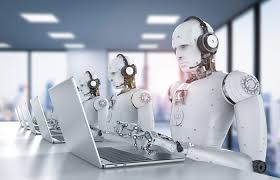
Robot Recruiters to end work discrimination?

There is no doubt that we have some discrimination issues in the workplace. There are an unlimited amount of stories on women not getting equal pay for equal work, glass ceiling, managers preferring workers of certain color or maybe interviewers giving the job to the candidate with the higher social status instead of qualifications. but what if these interviews were conducted by a robot recruiter? one that neither knows or cares about a candidate’s race, gender, religion, appearance or any other potentially influencing factors?

While some people feel uneasy about the idea of robot-cops or robotic doctors, the benefits of a robot recruiters far exceed any concerns and the idea is actually pretty reassuring. ‘Furhat Robotics’ have developed such a robot named Tangai that has been getting tested since last October in a recruiting firm and was proven very successful.

Tangai is a disembodied robot head with a friendly approachable face designed to mimic humans’ speech and mannerism. In addition to not having bias, this robot also does not do small talk in the interview to ensure that it only record work related answers. It asks the questions in the same sequence and the same tone then it gives the transcript of the interview to humans recruiters or managers to assess the candidates and decide accordingly.

Of course, no matter how promising these robots are, we need to keep working on tackling down our human biases. This discrimination phenomenon is worldwide and it does not just happen in the interviews but also at the CV assessment stage and even after the candidate start the job. It would be foolish to think we could just use technology to solve this issue without educating ourselves on this social and ethical issue.

Resources:

https://www.independent.co.uk/voices/robot-ai-work-discrimination-racism-unconscious-bias-a8838516.html

Sophia

The first time we discussed sex robots in class without viewing pictures and videos of them. I never thought that one day there will be an object that looks and acts in an extremely similar way to humans, to an extent that it could replace humans. After viewing the in class videos and listening to conversations between humans and robots I was amazed, but a little bit terrified also. About how they look exactly like humans, and how the artificial intelligence feature made them even act like us and respond to our answers in an appropriate way. The sex robots have been our topic for several classes, and really after realizing that Sophia an AI robot who was the first to be granted citizenship in Saudi Arabia; I was more amazed by how now robots can really replace humans. Moreover, when in class we discussed how in Japan refugees are not allowed to have a japanese citizenship while robots can; this does not only make me realize that robots will one day be like us, but they could also one day have the upper hand among humans.

Here is a picture of Sophia the social robot.

Universal Basic Income: The solution to machines replacing humans

Universal Basic Income (UBI) is an ambitious social policy that aims to provide all citizens regardless of income with a monetary monthly grant with no strings attached. The grant would put the individuals just above the poverty line. This policy aims to eliminate economic insecurity so that people are able to use their free time to innovate, create, and improve themselves. A famous social experiment called the Mincome research was carried out in Manitoba, Canada, where UBI was implemented. The results concluded that only 1% of the recipients stopped working, mostly to take care of their kids On average people reduced their working hours by less than 10%. The extra time was used to achieve goals like going back to school or looking for better jobs.

I believe that this is the solution to machine replacements because an educated, multi-skilled individual is an individual that is difficult to replace. The vast majority of people seek self betterment and self actualization, therefore they would not be content with sitting at home and receiving a monthly check from the government. If these individuals cannot find jobs in the market dominated by robots, they would be able to become entrepreneurs with their newly acquired skills.

Machines having feelings

She is talking about how AI is developing to the point that she is wondering if it may one day have conscious and feelings. She is saying that soon robots are going to be romantic partners, take care of children and fight is wars then science fiction will turn to science facts. She also talks about super intelligence can turn into consciousness. This ted talk was three years ago and she is talking about how AI are going to develop more in the future, which mean that this year that we are in now is part of the future she is talking about. The things that she is talking about are probably going to happen really soon.

Machines replacing humans

i found this video very informative yet fas, so i wanted to share it. In the video it was shown how tools started by the invention of the bronze that removed the jobs of the people that use stone tools and then iron tools were invented and removed the jobs of bronze users. Then how machines were invented during the industrial revolution that also required only few people to work on. The video also gave modern examples of how machines became faster and much smarter as for instance, people that work in the bank are replaced by ATMs. Not only the basic jobs are being replaced, even jobs that require high skills due to the invention of artificial intelligence. He mentioned a very important point he said ” They could do many of the things that we thought made us human”. Replacement of humans even came to cooks that may be replaced by machines that know the recipes. 47% of the jobs are going to be replaced by technology in the future, which is actually terrifying.

Quantum Computers

Computers have transformed our lives in so many different aspects. They enabled us to calculate, store, input, and output information, and from those simple operations, the fields of programming, robotics, and AI emerged and continue to grow till today. We are approaching a new different technology that can further amplify our capabilities. This technology is quantum computing. As the name may suggest, this technology is associated with quantum mechanics that include subatomic particles such as electrons and photons. Those particles behave differently from the natural laws that we can observe and sense.

One of the characters of these particles is the superposition. It can be understood by knowing the simplest units that a computer consists of: bit. Each bit in the computer contains one particular value: either 0 or 1, and all the information processed in the computer are changed into values of zeros and ones that the computer can understand and operate accordingly. In a quantum computer, this binary identity in the bit is blurred. A quantum bit, which is a subatomic particle, does not have a definite value; its value is a spectrum of range between 0 and one. For example, a single quantum bit might have a 50% probability of 0 and 50% of 1. The same bit can have different possibilities such as 74% of 0 and 26% of 1. However, when this bit is read, it either gives 100% 0 or 100% 1. The power of this characteristic is that it exponentially increases the operations that can be done by a couple few bits. An implementation of this technology is keys that can have unbreakable encryption codes, which will reduce incidents of hacking institutions such as banks and personal information on internet accounts, and that will lead to safer networks all over the world.

Another interesting characteristic is the entanglement, which connects two or more quantum bits in a way that if any bit is changed, others change spontaneously and accordingly no matter what the distance between them is. Using this feature, we can know the information of a bit by looking at its connected one.

Both superposition and entanglement allow us to perform operations much more efficiently and quickly. Nevertheless, there was an experiment done by Shohini Chose’s team and presented in a Ted talk that blew my mind. She presented a coin flipping game that relies on luck. It starts when player A chooses to flip or not flip the coin. Then player B, not knowing the new face of the coin, chooses to whether flip or not flip the coin. Player A makes the same choice, and then the face of the coin is revealed. If the face matches the one that was first seen at the beginning of the game, player A wins. Otherwise, player B wins. When the quantum computer was player A, it did not choose a specific face for the coin: head or tail. The face was instead a combination of both, so it remains the same whether the player chooses to flip the coin or not. At the end of the game, the computer outputs the bit as the original face of the coin. By doing so, the computer almost won all the games in the experiment although the game has a winning chance of 50:50. Such a game made me think of the abilities robots and AI might have if their hardware became a quantum computer and programs similar to the game were designed for those them. Would they have the ability to trick others as humans do? Does this mean that they would acquire the conscious that we always brag about as humans? And would they be any different from us?

Shohini Chose Ted Talk

https://www.ted.com/talks/shohini_ghose_quantum_computing_explained_in_10_minutes?language=en

The Destiny of Our Data

Everyday, we use our information everywhere without giving any attention as to where this data is going, or how one day it might be used against us. We assume that any data shared on the web is as safe as it could be as long as it is in a reliable and well-known source. Little do we know that today, according to AVtest, more than 250,000 malicious computer programs are born everyday, giving access to thousands, maybe millions, of hackers all around the world to our most private and protected data.

As much as technology made everything so much easier for us, it also made us extremely exposed and has created many traps to fall in. Thanks to our reliance on exchanging everything online, whether information, purchases, or even messages, a whole new world was created. This world, the “cyber attacks” world has so far resulted in thousands of helpless people being spied on, blackmailed or even going bankrupt. Cyber attacks can be as harmful as causing someone to go into deep depression or even someone, especially kids, to commit suicide. For instance, everyday we hear about new games being created which manage to lure countless kids in and end up knowing more information about them than their own parents. This also goes back to the fact that the web nowadays is not monitored, and basically anyone can create any domain or account with just a few clicks, whilst also convincing people that this is a website to trust and share any personal data with.

Although it may seem difficult, but the more technology advances, the more we should be aware of its complications and dark sides. To many of us, the internet has eased many processes and made our lives heaven, but to many others, the internet is the best platform to access anyone’s life and know the deepest and most hidden secrets hidden on that computer. To many, the internet is a method to make some people’s lives a living hell. Therefore, we should be really careful as to what we post and what we don’t, what we reveal and what we don’t. Always have a backup plan; never use your main credit card, maybe use a subsidiary one or allocate one to online shopping only. Be super careful as to where you post your email or phone number. Finally, as much as we hate to admit it, we all might fall victims of clickbait or targeted ads. Well, think twice and just remember that you never know who’s hands your personal data are falling in.

A.I. should we fear it or pursue it?

In pop culture, A.I. has always been depicted as this evil thing that will destroy the world and lead to the extinction of the human race. purely because we don’t understand it and because nobody has even come close to figuring it out yet. perhaps people fear A.I. because we are afraid they will punish us for all the mistakes we have made like destroying the planet slowly or all the wars that were caused by humans. we are also afraid that it will be smarter than us and be superior to us. in 2017 Mark Zuckerberg and Elon Musk had a debate on whether A.I. should be pursued after or not, as the discussion continued, Musk stressed on the fact that A.I. could lead to an extinction of the human race, while Zuckerberg said that we need the A.I. because it will help us in so many fields. after the discussion, Facebook had to shut down one of their A.I. projects because they created their own language and started communicating with it. so Facebook had to shut it down. we all have to admit that this is something out of a sci-fi movie.

Cyborgs and how they apply to my project.

This video applies to so many things we have discussed in the course and it also applies to my project. First, it applies to the cyborg manifesto by Donna Haraway because her definition of a cyborg did not classify all humans as cyborgs because according to Amber Case, cyborgs are humans that use tools to enhance their lives so if we use mobile phones in any way we become cyborgs. while Harraway described cyborgs as a human with mechanical parts attached to him which might be the same thing because attached can mean various things such as being close to your body such as how close our mobiles are to us. it also applies to my project because according to Case all humans are cyborgs which makes my argument clear and proves my point. Case also highlighted Digital Humans which is a human that performs all his tasks digitally which is the case about almost every singe youngster out there so it also proves my point. Case also shed a light on the use of technology as it was originally intended to save time not waste it. while now most of our time is spent with technology as she mentioned a study conducted in a research institute called Xerox Park in which they had a theory that in the future technology would be cheap and attention will be expensive this is due to the fact that most of our attention nowadays is towards technology.

https://www.youtube.com/watch?v=U2gP1dst_Kc

The Walkman crisis and how it relates to us now.

My project is about the relationship between people and technology and how it can affect us psychologically. one of my sources for the project is “Doing cultural studies: the story of the Sony Walkman.” (Du Gay, 1997). i used this source because it showed me the worry of the technological advancement back in the 1980s and the 1990s before the technological advancement we have now. another reason why i chose this article is to show my interviewees that this has been an issue for years and that it was a warning to what is happening now. also i wanted to show that people stopped talking about this as a problem and started treating it as a normality. it was also to show them one type of the relationship between human and a piece of technology as it was mentioned in the article that people would spend hours doing nothing but listening to music on their walkman and it became a huge part of their day as it with them everywhere. in addition, i wanted to show the effect of such a device on the relationships between people and their family and friends because this device can completely shut out the world to the person using it that includes shutting out your family and friends so it can destroy relationships and that was only a music player. a cheap smartphone has a music player in default and there are many more possibilities of people shutting out their loved ones. for example, many people experience the feeling of sitting among your friends and family with each of them on their phones. that is why i chose this article and this artifact.