“I’m a little trembly…”

Although this might not seem like an extremely relevant or important topic, it is a small observation I made during an online lecture. As AUC begins its daring journey into the online teaching path (accompanied by the majority of universities around the world), many have made the claim that this response to a global crisis could prove the concept of online teaching as a standardized mode. 

Regardless of the academic implications or the consequences of a sudden shift, there was one aspect that I would like to bring to light, the power of human interaction. During a lecture by a professor who will not be named out of respect, the lecturer began by staring with wide eyes into the camera then began. She started off by saying in a broken tone: “Good evening everyone this will be the lecture for Section 6.2. This will be the first time I give a lecture to a void in a screen, but I invited Dr.X in here because I simply cannot do this without some human feedback. Excuse me but I am a little bit trembly, I will try my best inshallah.” Now to me it was a rather intriguing start to the lecture, as it made me focus more on what the professor was going to do differently. I found that they were often glancing back looking for feedback, then giving a snark facial expression of disapproval when they realized feedback would have to wait. The professor often found themselves asking “any questions?”  to the empty classroom every now and then, only to be met with silence. The lecture continued as the doubtful professor kept questioning how well of a job they were doing, whether they were going too fast, or if they could answer any questions for their beloved students. Alas, this was not an option.

My point being, through this small observation, is that online classes have taken out the human interaction that builds a relationship between teacher and instructor. The connection that skilled professors have learned to establish in order to better inform students and spark their interest has been sucked out due to these pre-recorded lectures. The impact of this, I believe we will witness very soon.

https://www.facebook.com/VICEAustralia/videos/1282947268581626?sfns=mo

For the past decade or even prior to that, new modern technology devices and humans have been inextricably entangled. They always serve humans ‘ needs and desires to perform their daily tasks in a simple manner to avoid the hurdle of over complications and even the stress of getting everything done in a matter of time. However access to some joy and entertainment in life never hurt anybody. Well, according to this video posted by VICE Australia, the desires of men wanting to have sex whenever they want and getting the most out of it is apparently available. There are two men in the video one of them is the manufacturer of these sex dolls, which he tried creating them with minds as well as emotions, introducing  them to the other man. “I’ve made a brain that I know can have emotions in many ways.”Honestly the capability of owning a doll or a robot mainly designed to perform a distinctive task who can feel, tell jokes, laugh; indicating a presence of sense of humor, and reply to people talking, kind of amazes me. The manufacturer claims that having sex with a doll is even much better than with a woman human being, emphasizing that the sex act remains the same in both cases. 
I’m not really sure about the pros of the availability of such sex dolls, but from my own point of view I think it does really serve some men’s or non-straight women’s needs in a way or another. It is even considered affordable as per the manufacturer stated in the video, the doll is only 4000 dollars and I think it could be regarded as a long-term investment, people can trade it with each other and exchange them together, without any complications. Also such robots highlight how far the world has gone with it’s infinite innovations. Last, there will never be a society as a whole that fully agrees or disagrees to the presence of something, therefore the same apply to these dolls or special effects robots.
I am really excited to read about or watch how far can innovators go on with new ideas applied to their work.

Detroit Become Human

Detroit Become Human is a video game created in a third person point of view in which the player controls most of the character’s decisions. The video game allows the player to play as three characters, all of them being androids. The first one is a caretaker android named Markus who turns deviant and disobedient after gaining consciousness. Markus then tries to free others from abiding by their expected behavior. The second android was a police investigator named Connor, working with lieutenant Hanks who was an alcoholic that absolutely despised androids. Connor was mainly programmed to hunt down deviant androids such as Markus. The final character is an android named Kara. Kara is a housekeeper android that takes care of a little girl. In Markus’s case, he is the savior of all androids that gains consciousness and leads the rest of the androids into protests. Markus has the choice of whether or not to turn these deviant androids into becoming aggressive. On the other hand, Connor is an android that abides by his programmed behavior and may only deviate and become self-aware by the end of the game based on the player’s decision. Even though Connor expresses the most humanity, unlike other androids, when Connor dies mid game, he will instantly be replaced by another “Connor” and the game will continue as if he never died. This makes us question what we perceive as “alive”. This shows that even though we might feel as though Connor might be a human, this thought is debunked by the fact that he is replaceable and therefore nonhuman. The third android, which is Kara, who might gain consciousness in order to act as opposed to her programming and actually protect herself and the little girl from the abusive father or just act as expected of her and get destroyed by him. Additionally, if the player doesn’t let Kara become self-aware, Alice, the young girl she was supposed to protect, will die. After a while it’s revealed that Alice is in fact an android made to act as a replacement of the father’s daughter while her mother took her away. After this revelation, players might feel a sense of manipulation as some of the decisions made were to protect her as if she were a human. But that raises the question as to whether we would’ve treated the android differently and why? Would we have put the “life” of Kara at stake knowing that Alice was an android? Or would we have let them both die as they aren’t necessarily “alive”. Another concept depicted in the video game is the uncanny valley, since, during the game, players would come across multiple protests made by humans against androids due to people starting to not be able to tell the difference between humans and androids. This shows how humans tend to get uncomfortable and go to the extent of despising androids when they start to resemble humans way too much.

Human-Machine Interactions

Do we like robots better when they look like us? Are we more likely to empathize with machines  -real or fictional- if they look or interact like us ? These articles, as well as many others, suggest that the answer is yes. The second article references a study that asked participants to carry out certain activities with a robot and then turn it off. In roughly half of experiments, the robot protested, telling participants it was afraid of the dark and even begging them not to shut it off. The result was that half of these people refused to turn it off and the rest took twice as long to do so. What we can infer from this is that we tend to attribute human feelings and emotions to robots that interact with us socially in ways we are familiar with even when we know that they’re just machines that were programmed to react this way. Our anthropomorphic tenancies are apparent in everything from ancient mythology to how we design robots and portray them in science-fiction, and these tendencies seem to complicate our relationship with robots immensely. They give room for us to empathize with the terminator who is essentially a killing machine and allows movies like “Her” to romanticize a man falling in love -and lust- with a glorified Siri. And while sex toys have always been a taboo subject, they didn’t spark the current sensationalist controversy in popular culture until they were made to look like humans. Despite there being no definitive answer as to why we feel the need to anthropomorphize, it can be attributed to many things including simple human egoism, our need to interpret the outside world through terms that are familiar to us and in terms of our own senses,  or as Kate Devlin states it is simply “the most successful form in nature and that its easier to design a robot to fit our world than to redesign all our tools to fit them”. Whatever the reason behind it is, this need seems to be at the core of many of the ethical controversies regarding the development of robots and our relationships and interactions with them.

Do we like robots better if they look like us? Marco Tempest, 2014

New study finds it’s harder to turn off a robot when it’s begging for its life https://www.theverge.com/2018/8/2/17642868/robots-turn-off-beg-not-to-empathy-media-equation

Altered Carbon

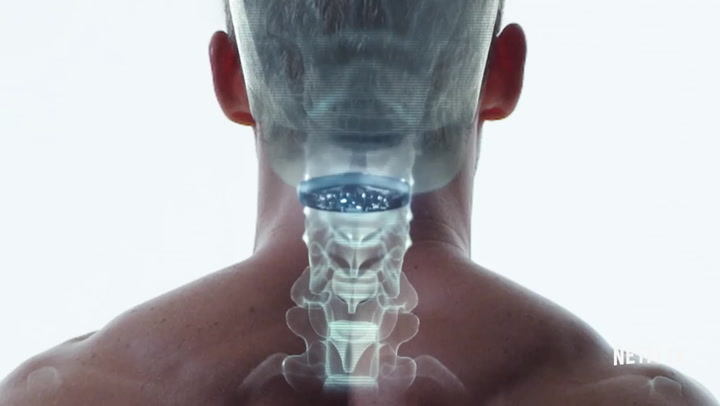
Altered Carbon is a show that takes place many years into the future where death can no longer exist between certain societies. I’m saying certain societies because only the rich (known as the “meths” in the show) can afford to continuously avoid death. See in the future, everyone has a “stack” which is located at the very top of their spinal cord.

Image result for stack altered carbon

Inside the stack is a human mind, in other words your consciousness. To make it easier just look at the stack as an SD card that holds all your memories. Now let’s get to the juicy part of it, your stack can be placed into any “sleeve” (a sleeve is a human body) and in turn you would be alive and well except you’re in a completely different body, pretty simple. However, if your stack gets destroyed, let’s say for example someone shoots u right in the neck which in turn damages your stack, now that’s real death there’s no coming back from that. However, the filthy rich can afford to upload their consciousness to the cloud (satellites that hold their consciousness), so even after someone shoots their stack, they can simply reupload their consciousness via the cloud and re-sleeve into another body. I found this show interesting because human bodies are seen as machines, quite literally actually. companies try their hardest to biometrically produce the best possible human being so the rich can buy them to re-sleeve into them. It’s ironic how in that portrayed future the human is defined as a stack, a piece of machinery, instead of a live organism. While on the other hand, the human body becomes a suit, disposable and classed based on the preference of the stack. The definition of what’s human and non-human switch completely. I’ve linked the trailer down below for anyone interested in seeing the show.

Japanese Gaming Bed

I was scrolling through Instagram, and came across this photo. I wasn’t really surprised when I saw this, because most kids, nowadays, spend their weekends playing playstation for hours. However, the concept of this gaming bed is a bit frightening, since it will make people get use to technology being always a few centimeters away. Firstly, it will make them become more anti-social, since they will spend most of their time on their laptops, phones, computers, etc. Secondly, their physical activity will decrease, because they start to be lazy and stay in bed all day. Moreover, since they’ll have their snacks and drinks next to them, they will have no need to get up from their bed. Thirdly, I think that if the person using the gaming bed is constantly playing violent games, it might make them more aggressive with others. I have witnessed this through many of cousins, even though they might not be playing these games daily.

As shown in the image below, the man has his phone close to him, and is doing no effort at all to hold it. I think that is extremely dangerous to his eye sight, because he is going to be looking at the screen for a long time and it may stop him from being able to sleep at night.I think that technology has become an essential part of our lives. We have depended on it for assistance in our daily lives. However, it has many negative aspects. I think that is basically the question we are constantly asking ourselves, throughout this course, which is if technology is good or bad for humans.

Greta Thunberg Sex Doll

If you’re anything like me, or even remotely human, the above title probably would have triggered a gut-wrenching feeling of disgust. I’d like to calm you all down by first stating that the doll was not produced in the end.

The theoretical sex doll was first posted to Reddit by a now deleted user. The post has also been deleted on both Reddit and Twitter.

Hate or love her, Greta Thunberg is undoubtedly one of the most prominent figures today. The now 17 year old activist took various stances and made her voice heard. Nevertheless, she has also received a gigantic amount of backlash and harassment by users online. While many criticize her comments as vain and uneducated, the lovely underground users of Instagram, Twitter, Reddit and so on have managed to ridicule the young activist. Many have made fun of her disability while others simply labelled her as an attention-seeking child.

One user however took a more extreme stance against the Swede. A Reddit user, who was deleted shortly after making the post, claimed he had designed a sex doll modelled after Thunberg, claiming that he programmed it to say “How Dare You” and other statements from Thunberg’s infamous speeches.

Yes, this is rather disturbing. However, as aforementioned, no company was eager enough to produce the doll. Thankfully. Regardless, this whole viral fiasco made two previously obscure questions clearer than carved crystal.

The first question to be explored is obviously the question of minors. Should sex dolls be allowed to impersonate minors. a 2008 study by Michael Seto of the Royal Ottawa Healthcare Group revealed that about 5% of the general population have a certain attraction to minors. This upper-estimate was done by analyzing the physical reactions (pulse, blood pressure, blood flow to sexual organs) of random adult population samples to pictures of various individuals from different age groups. While this statistic is absolutely mind-boggling, it is important to note that number drops to less than 1% if pre-pubescent children are considered. Nevertheless, there is a significant portion of the population attracted to children and teens. Should this portion be allowed to order custom sex dolls mimicking minor populations? Personally, I believe this should be illegal. Nevertheless, illegal activities always prevail. Should people having intercourse with minor sex dolls receive the same penalizations as having sex with minors?

The second question that arises is the question of impersonations. Should people be allowed to order sex dolls imitating real individuals. Whether those individuals are celebrities, or just your average citizens, I personally believe that this huge invasion of privacy should be strictly prohibited. However, I do believe it is inevitable.

EXTRA: I hope everyone is doing fine in this post-apocalyptic week we’re experiencing. As you probably know we should be trying to interact as much as possible through the blogs. I tried to leave many loose-ends in this post so that we can try to have our own little debate in the comments. So let me know what you all think, we can try to get a thread going.

HER (2013)

The argument about whether the modern technology unstoppable innovations are in our human nature’s favor or not has been arising rapidly for a remarkable period of time. I’m sure we’re all on the side that these innovations enhanced and keep enhancing our daily lifestyle continuously and that there is no doubt that life would be hard without such modern tech revolution. However as per my anthropology course’s point of view, are these enhancements turning us to unwanted cyborgs even-though we are in our human bodies ? Are they taking us away from mingling with the environment surrounding us ? 


After watching the movie HER by the Oscar Award Academy Winner actor Joaquin Phoenix, a new perspective of technical attachment drew my attention. In fact as much as I would hate being separated from a technical device or a social media account that I’ve been lately attached to, the ending of the movie was indeed a heart-breaking one, seriously ! Falling in love with a new operating system operated by a voice of someone you never saw and would never see as in real life but only contacting them through an OS; Samantha who is the voice behind his OS1 (depicted in a type of an earphone related to the system) , right after Theodore’s marriage ended, was something I couldn’t have imagined how it would have continued. However seeing the sensible Theodore this joyful finally after a while of being in touch with Samantha, didn’t go as planned since she is an OS. Although she helped him to deal with several issues and conflicts he was facing, she couldn’t help any further with his inner conflict of being in love with an OS. She was only designed to cater the needs of the person she’s being in touch with.  
This had drew my attention of whether or not this could occur to any of us any sooner. Would further recent innovations become like Samantha and all of a sudden leave? Or would I spontaneously acknowledge that they are operating with other hundreds or even thousands of people ? Truly, no one can ever deny the benefits of technology and their uses, but what’s next is what concerns a minority of people who are afraid of being emotionally attached to items that do not have a body in fact, such as social media accounts, OSs and maybe even things we do not know that they currently exist. 

In Time 2011

In Time is one of the most interesting sci-fi movies I’ve seen. It’s about a futuristic world, where you live depending on how much time you have. So, after 25 years of age, you have to buy time to live, either through a job or getting deposits from others. As shown in the picture on the right, the amount of time you have is displayed on your hand. Your body has a system or a ‘robot’ that functions depending on the amount of time you. For example, Justin Timberlake’s mother runs out of time, because she was poor (she had little time), and dies. The society revolves around the expression, ‘time is money’, since you pay everything with time, whether it’s transportation or even food. The rich possess an immense amount of time, making them almost immortal, while the lower class suffer and struggle to survive. I think that this is related to the theme of Cyborgs, because it shows how both human and machine combine to create a whole society. It is however, very unfair how a robot inside of you is taking control of your fate, since you now have minimal control of your own fate. For instance, if someone robs you and takes all your minutes you die. Here’s a link to the trailer on Youtube, if you’re interested to watch the movie!

An Episode in the Series Black Mirror Called “Be Right Back”

This episode starts off with a young couple, Martha and Ash, who have just recently moved to Ash’s remote family house. A day later, Ash dies in a car accident and Martha is left to mourn. Martha’s friend, Sarah, offers to sign up Martha up to something that might help her by allowing her to speak to Ash. In other words, it’s a type of technology that allows her to communicate with an artificial intelligence simulating her late husband Ash (by analysing all of his previous interactions on his phone including messages and comments). Disregarding Martha’s heavy opposition towards signing up, Sarah sends Martha a message informing her that she signed her up. Shortly after that, Martha gets a message from her late husband Ash (and it sounds so much like him that Martha quickly gets attached). After returning from the doctor to check how her pregnancy is going, she drops and breaks her phone while calling Ash and he stops responding. Martha instantly gets a new phone and suddenly Ash starts calling. Martha starts crying and apologizing to Ash in which he replies “you don’t have to worry about breaking me, I’m not in that thing, I’m in the cloud.” Moreover, Ash introduces a new level in which he can be physically there with her. She does as he says so he becomes an physical android imitating and mimicking her late husband’s words and actions. Martha starts to get creeped out and annoyed by the android as he obeys exactly as she says and isn’t acting the same way Ash would. So when Martha orders him to jump off the cliff he obliges; she then gets angry at him and proves the point that he is different from the real life Ash, as Ash would’ve been scared and would have disobeyed her. In the end, Martha keeps the android in the attic and allows her daughter to see him only on the weekends and has an exception to see him on her birthday. In conclusion, this matches the definition of the uncanny valley as the android became the closest it could be to the real life human that Martha started getting uncomfortable and the android appears as repulsive and eerie.

Be Right Back~Black Mirror